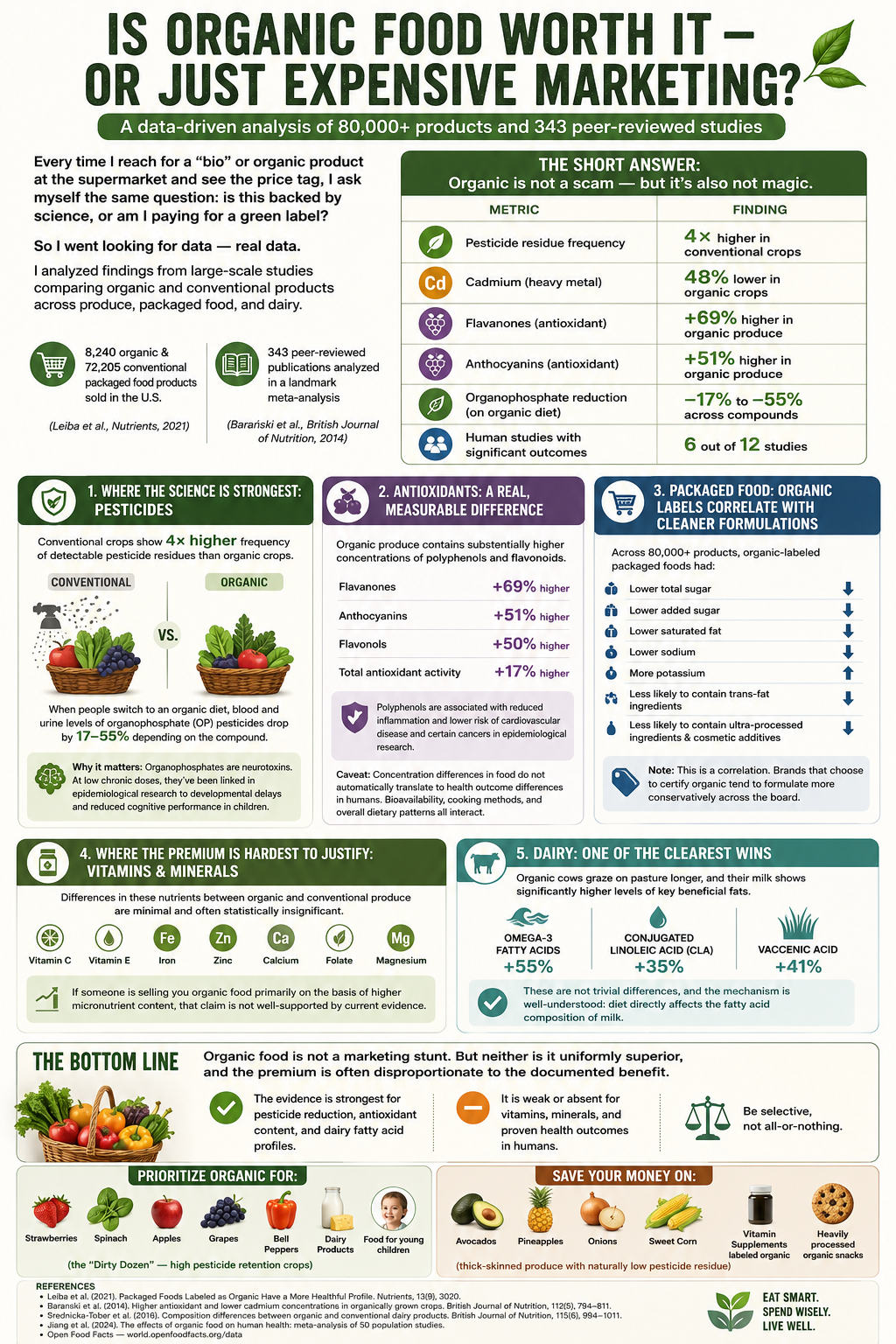
Everyone says organic is better than conventional. So I did what any slightly unhinged person does at 11pm — I actually looked at the data. 343 peer-reviewed studies, 80,000+ products, several cups of tea I forgot to drink.
Here's what I found — and it's more nuanced than the marketing wants you to believe.
The €5.49 question
Conventional eggs at Auchan Luxembourg: ~€3.25 for 12. Bio eggs: ~€5.49 for 6. That's roughly 3× the price per egg. So is it actually worth it?
Let's see what the data actually says.
Where the science is strongest: Pesticides
Conventional crops show 4× higher frequency of detectable pesticide residues than organic crops. When people switch to organic, organophosphate levels in blood and urine drop 17–55% depending on the compound.
Organophosphates are neurotoxins. At low chronic doses, they've been linked in epidemiological research to developmental delays and reduced cognitive performance in children. This one matters.
Antioxidants: A real, measurable difference
Organic produce contains substantially higher concentrations of polyphenols and flavonoids — and this is backed by hard data:
Polyphenols are associated with reduced inflammation and lower risk of cardiovascular disease and certain cancers. That said — concentration differences in food don't automatically translate to health outcomes in humans. Bioavailability, cooking methods, and overall dietary patterns all interact.
Dairy & Eggs: One of the clearest wins
Organic cows graze on pasture longer, and their milk (and eggs) show significantly higher levels of key beneficial fats. The mechanism is well-understood: diet directly affects fatty acid composition.
These are not trivial differences. This is why bio eggs are one of the cases where the data actually says: yes, the premium is justified.
Where I've been wasting money
Differences in vitamins and minerals between organic and conventional produce are minimal and often statistically insignificant. If someone is selling you organic food primarily on the basis of higher Vitamin C, iron, zinc, calcium, or magnesium — the data doesn't support that claim.
I have been paying premium prices for vibes.
The actual cheat sheet nobody gives you
- Eggs & dairy products
- Strawberries
- Spinach
- Apples
- Bell peppers
- Grapes
- Food for young children
- Avocados
- Pineapples
- Onions
- Sweet corn
- Vitamin supplements labelled organic
- Organic snacks & processed food
The "Dirty Dozen" crops (strawberries, spinach, apples, grapes, bell peppers) absorb pesticides through their thin skins — those are the ones that matter. Thick-skinned produce like avocados and pineapples have naturally low residue regardless of how they're grown.
The finding that surprised me most
Across 80,000+ products, organic-labelled packaged food tends to have lower total sugar, lower sodium, fewer ultra-processed ingredients, and less trans-fat. Not because "organic = healthy" — but because brands that bother to certify organic tend to formulate more conservatively across the board.
It's a correlation, not causation. But it's worth knowing.
Now if you'll excuse me, I need to return this €5.49 egg decision to the "probably worth it actually" column and move on with my life.
📚 Data Sources
- Baranski et al. (2014) — Higher antioxidant and lower cadmium concentrations in organically grown crops. British Journal of Nutrition, 112(5), 794–811.
- Leiba et al. (2021) — Packaged Foods Labeled as Organic Have a More Healthful Profile. Nutrients, 13(9), 3020.
- Srednicka-Tober et al. (2016) — Composition differences between organic and conventional dairy products. British Journal of Nutrition, 115(6), 994–1011.
- Jiang et al. (2024) — The effects of organic food on human health: meta-analysis of 50 population studies.
- Open Food Facts — world.openfoodfacts.org/data · 80,000+ product database.
* Prices approximate, based on Luxembourg supermarket averages (Auchan, 2025).